Sponsored
Understanding injectable trace minerals (ITMs): A factual guide for your herd

Sponsored by

An injectable trace mineral (ITM) supplement for cattle delivers a targeted dose of zinc, copper, manganese, and selenium exactly when you need them.
For farmers looking to optimise herd health, fertility, and immunity, here is the factual breakdown of how it works, why it is used, and the clinical benefits it offers.
Why oral supplementation often falls short
Most production systems in Ireland rely heavily on grass and grass-based forages, which are frequently deficient in essential trace minerals, especially copper and selenium.1
Even when oral supplements (like licks, boluses, or in-feed minerals) are provided, cattle may only absorb a fraction of what they consume.
- The rumen antagonist problem: Elements naturally found in forage and water such as sulphur, molybdenum, iron and calcium act as antagonists in the rumen. They bind to trace minerals, severely reducing their absorption and availability to the herd.
- Variable intake during stress: During critical periods of high demand such as calving, weaning, housing or transport, dry matter intake naturally drops. This means that trace mineral intake is lowered when they need them the most.
How the injectable works
By administering trace minerals via a subcutaneous injection, they completely bypasses the digestive system and the rumen antagonists.
Absorption is highly efficient as blood mineral levels rise within 8 to 10 hours,2 and the minerals reach vital storage organs like the liver within 24 hours,3 ready to be utilised by the animal's immune and reproductive systems.
Proven clinical benefits
Using ITMs strategically to top up trace mineral levels ahead of stress periods has been extensively trialled, showing significant improvements in health and productivity:
- Dairy herd health: Providing ITMs during the transition period supports fresh cow health. Trials demonstrate a reduction in clinical mastitis by up to 22% and sub-clinical mastitis by 23%.4 Furthermore when ITMs are supplemented at dry-off, 30 days pre-calving and 35 days in milk (DIM), supplemented animals experienced 74% less mastitis in the first 30 DIM.5
- Reduction in fresh cow disease: The period immediately before and after calving places immense stress on trace mineral reserves. During this time, treated herds showed significant reductions in the incidence of metritis6 and endometritis,7 alongside a 29% reduction of stillbirths.8
- Increased productivity: Dairy cows supplemented with ITMs 30 days pre-calving showed a statistically significant 8.5% increase in milk yield and a 2.7% increase in milk protein content.9
- Fertility and calving: In suckler and dairy systems, administering ITMs 30 to 10 days pre-breeding improves conception rates, including a 9% higher conception rate to fixed-time AI (FTAI).10 This improved conception rate resulted in 12.5% more cows calving in the first 20 days of the calving block, compared with non-supplemented cows.11
- Calf Health and Vaccine Repsonse: Youngstock have a high demand for trace minerals to support rapid growth and combat the stress of weaning or transport. Calves supplemented with ITMs saw an 8% reduction in diarrhoea and a 7.5% reduction in pneumonia and otitis.12 Research demonstrates that calves administered ITMs alongside vaccination produced antibodies at a faster rate13 and maintained higher antibody levels14 than those administered vaccine alone.
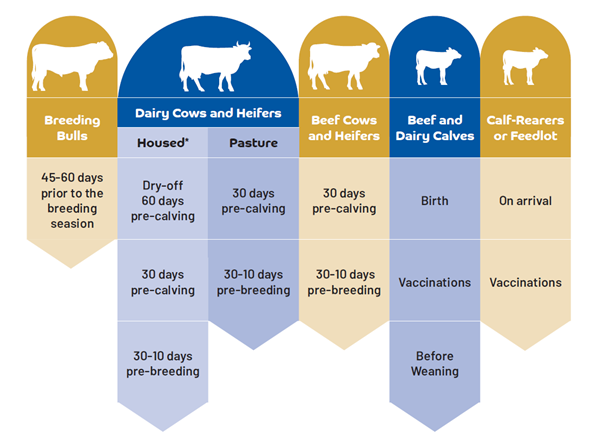
Strategic dosing timeline
To get the best return on investment, ITMs should be administered ahead of critical stress points in the production cycle.
- Rogers, P.A.M and Murphy, R. (2000). Levels of Dry Matter, Major Elements (calcium, magnesium, nitrogen, phosphorus, potassium, sodium and sulphur) and Trace Elements (cobalt, copper, iodine, manganese, molybdenum, selenium and zinc) in Irish Grass, Silage and Hay. http://homepage.eircom.net/~progers/0forage.htm ↩︎
- Pogge et al. 2012. “Mineral concentrations of plasma and liver following injection with a trace mineral complex differ among Angus and Simmental cattle”. J. Anim. Sci. 90, 2692–2698. ↩︎
- Ibid. ↩︎
- Machado VS, Bicalho MLS, Pereira RV, Caixeta LS, Knauer WA, Gilbert R, Bicalho R. Effect of an injectable trace mineral supplement containing selenium, copper, zinc and manganese on the health and production of lactating Holstein cows. Vet J.2013 Aug;197(2):451-6 ↩︎
- Guadagnini M, O’Neill pF, Oxtoby T, O’Rourke D (2023) Role of strategic trace mineral supplementation on udder health and its economic implications in a UK dairy herd. Oral communication at XXV Congreso Internacional ANEMBE de medicina bovina, Leon, Spain. 24th-26th May 2023 ↩︎
- Dzermeikaite, K et al. (2025) The role of injectable trace mineral treatment in dairy cow health:impact on metritis, milk production and composition. Poster presented at: XXIV Middle European Buiatric Congress, Kosice, Slovakia, May 7-10, 2025. ↩︎
- Machado VS, Bicalho MLS, Pereira RV, Caixeta LS, Knauer WA, Gilbert R, Bicalho R. Effect of an injectable trace mineral supplement containing selenium, copper, zinc and manganese on the health and production of lactating Holstein cows. Vet J.2013 Aug;197(2):451-6 ↩︎
- Ibid. ↩︎
- Dzermeikaite, K et al. (2025) The role of injectable trace mineral treatment in dairy cow health:impact on metritis, milk production and composition. Poster presented at: XXIV Middle European Buiatric Congress, Kosice, Slovakia, May 7-10, 2025. ↩︎
- L.R Mundell, J.R. Jaeger, J.W. Waggoner, J.S. Stevenson, D.M. Grieger, L.A. Pacheco,J.W.Bolte, N.A. Aubel, G.J. Eckerle, M.J Macek, S.M. Ensley, L.J. Havenga, K.C.Olsen (2012) Effects of prepartum and postpartum injections of trace minerals onperformance of beef cows and calves grazing native range. The Professional AnimalScientist 28, 82-88 ↩︎
- Ibid. ↩︎
- Teixeira AG et al. 2014. “Effect of an injectable trace mineral supplement containing selenium, copper, zinc, and manganese on immunity, health, and growth of dairy calves”. J Dairy Sci. Jul;97(7):4216-26. doi: 10.3168/jds.2013-7625. ↩︎
- Roberts SL et al. 2016. “Effect of injectable trace mineral administration on health, performance and vaccine response of newly vaccinated feedlot cattle”. Prof Anim Sci.;32(6):842-8 ↩︎
- Arthington J, Havenga L. 2012. “Effect of injectable trace minerals on the humoral immune response to multivalent vaccine administration in beef calves”. Journal of Animal Science 90, 1966-1971 ↩︎
- Machado VS, Bicalho MLS, Pereira RV, Caixeta LS, Knauer WA, Gilbert R, Bicalho R. Effect of an injectable trace mineral supplement containing selenium, copper, zinc and manganese on the health and production of lactating Holstein cows. Vet J.2013 Aug;197(2):451-6 ↩︎
Sponsored by